Total Pageviews

Wednesday, 6 June 2012

Dusting Off the Rabbit Ears

It is so often the case that you never really know how lucky you are while you are in the midst of something until it is no longer there. Or, as Joni Mitchell far more eloquently put it, don't it always seem to go that you don't know what you got til it's gone. Well, I'd hate to apply that lovely, universal maxim to something as trivial as television, but dammit, we are lucky, and I'd like to take some time to wax poetic as to why.

Over the last five years, my interest in TV has been lukewarm to say the least. Reality television shows were seemingly self-replicating to diminishing and increasingly stupid returns, a trend that nowadays seem to only be getting worse (just how many pawn shops and storage lockers need their own damned show anyways?). I have been guilty of indulging in these awful shows in the past, but have since purged my appetite for them and rediscovered some truly great television in the process.

It is unfortunate that movies get more respect than most television shows these days. With a movie, even a great one, you get two, two and a half hours tops to tell an engaging story. Add a sequel, there's five hours. Trilogy? Seven or eight hours. The Lord of the Rings Extended Edition Trilogy is pretty much where this line of thinking maxes out at about thirteen or fourteen hours. Sure that is a long time to get to know characters, have a conflict, show some interesting settings, trade some dialogue, and wrap it up in a meaningful way, but what if there was more time? Like say sixty, seventy, or even a hundred hours where you could expand your characters and really breathe some life into them. That is precisely what shows like Mad Men, The Sopranos, The Wire, and Breaking Bad are doing. These long form shows are make even really good movies feel about as deep as a Where's Waldo book. Their characters are given room to really flesh out and exist in a world that actually feels lived in and real.
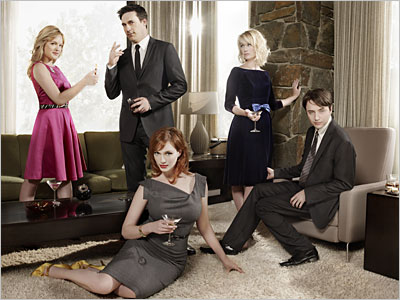
Mad Men is a great example of just how lived-in a television show can feel. The series begins in 1960, where misogyny and martini lunches were the norm. Women were considered second-class citizens and only filled secretarial positions. African-Americans were elevator operators and live-in nannies. As the show progresses, however, real life events are being documented (the JFK assassination, for example) and societal change is a tidal wave that is sweeping up every single character. Now in its fifth season and comfortably in 1966, women have more power (as evidenced in Peggy being a major copywriter), the civil rights movement is right at the doorstep (literally) and the younger generation is starting to push back at the "establishment" of advertising, thus exposing its sometimes archaic worldview. The best thing is that these events are practically happening in real time. The characters are aging along with the show, as well as the children. In fact, one of the many joys of Mad Men is watching Don Draper;'s daughter Sally start off as a blonde moppet in season one to a teenager with complex needs on the verge of becoming a flower child in season five, all the while being played by the same actress, the very capable Kiernan Shipka. You can't get that kind of verisimilitude from a film.


Speaking of verisimilitude, I don't think there's been a more in depth, realistic, or honest look at the police procedural than that of The Wire. You encounter characters and situations as you would in real life, without backstory or explanation. The pilot episode simply plunks you in the middle of a court case, leaving you to parse out what is going on as events unfold. Needless to say, The Wire is not for those who wish to be spoon-fed important details. For the viewer who puts in the time, however, the rewards are rich. Imagine any episode of Law & Order stretched out to a season's worth of detective work: collecting clues, planning strategies, making busts, fixing mistakes, and a whole lot of the ground-level bureaucracy that goes on in police work. This may sound boring, but on screen it unfolds like a classic novel, full of fascinating details and asides that are woven into a striking arc of five seasons worth of amazing television.

I came late to the Breaking Bad party, admittedly. I'd heard about it from coworkers urging me to watch, but shrugged it off for some awful, ridiculous reason. A year later and I have atoned for my sins, if only I could say the same for Walter White, the, ahem, hero of Breaking Bad. Through four seasons, a mild-mannered, cancer-ridden chemistry teacher has become a blood-spilling Michelangelo of meth. Show creator Vince Gilligan and his team of writers have added such depth, nuance, and tragedy into a show that is essentially about a good man turning into a monster. No small feat.

All of the aforementioned shows have been intense, moody dramas, but quality television does not stop at abortions, methamphetamines, and wire-taps. Comedy greatness is easy to find, which is mind-blowing since it is much more difficult to achieve than dramatic greatness. Louie, the show written, directed, edited and starring Louis C.K., is probably the most daring, original and hilarious show of the last couple of decades.  Eschewing format altogether, C.K. offers skits and scenes revolving around his usual stand-up tropes: sexual inadequacy, failed marriages, how awful children can be. These scenes are Gestaltan in their overall effect, mirroring what most of us so often fail to realize: life can be really fucked-up, but sometimes the best way to deal with a beheaded hobo is to laugh at him.

The next time someone tells you there's nothing good on TV, or that television shows peaked after The Honeymooners, Cheers, or (Lord help me) Two and a Half Men, know that you are most likely speaking to an ignorant moron (likely) or someone whose taste is absolutely dreadful (likelier, sadly) and shuns quality like most people shun root canals. To counter their stupidity, calmly remind them that the golden age of television is now, that most movie blockbusters are insufferably terrible, and that you can show them the way to redemption. After all, it's only a remote click away.


Tuesday, 22 May 2012

Back in the Saddle

Here I have been waiting for a return to normalcy with bated breath. Maybe normalcy is the wrong word, since normal has some very untoward synonym cousins like average, run-of-the-mill, common, typical, and conventional...all words I doubt very many people would be scrambling to affix to their lives. So if not normalcy, then what? Routine? Structure?

Its been three months since I've written or even glanced at my blog. At first it was nothing more than a minor neglect, like not feeding your goldfish for a day. You feel guilty, but its not the end of the world. Even if you forget the next day, your goldfish won't die. And then its been a week, then two weeks, then close to three months. If your goldfish is alive, which he probably isn't, he's super pissed and ready to settle the score. Its easy to forget about him, floating in his little bowl, not a care in his average life, and then when you least expect it, you get home from your dinner and a movie date and he's upside down. You think Jesus, all I needed to do was sprinkle a little of that weird smelling flaky fish food in there but two or three times a week, and this all could have been prevented. 


Well, I logged back into my blogger account, and lo and behold, Interrobang still exists. Zero page views in months (obviously), a little dusty, but by no means floating upside down, so its time to sprinkle some food into its bowl.

As I mentioned, life has been a series of peaks and valleys, none of which resemble normalcy. My wife and I had our first child together on April 22nd; the little guy decided to come seven weeks early. Three blurry weeks in the Neonatal Intensive Care Unit, leaving my job to go on parental leave early, having very short-notice sinus surgery, and dealing with relatives, gifts, cards, questions, concerns, nurses, doctors, hospital staff all have contributed to the last three or so months being focused on something other than myself (good thing I'm not a narcissist!). All of this brouhaha has offered some extremely valuable perspective, though. Things tend to snap into focus a little bit easier when there is more on the line than mere ego (but that is still there too, in spades). So now that my son is home and working his way into an established routine, my surgery is over and quite successful (I can breathe, taste, and smell again! Maybe all of thats not so overrated after all), and my job is safety tucked away for the next eight or so months, I can finally dust off my literary hat and work on something again. Speaking of which....

Earlier this year, I decided that I really need to pull up my bootstraps and get out into the great beyond to seek out, well, for lack of a better word, kinship. No man is an island, after all. Some quick googling brought me to Meetup.com, which took me to the Victoria Creative Writing Group, which then led me to my first of several meetups amid the towering emptiness of the Atrium building downtown. Initially I was skeptical of meetup consisting of writers talking about writing, dropping bon mots and quoting Flaubert. Well, thank Christ, I was wrong. The dozen or so regulars at each meeting are eclectic, witty (though not insufferably so), interesting, and most importantly, passionate. And passion is like a disease to me, you have to have it around before you can catch it. I haven't been to a meetup in a couple of months, but returning to them is an important part of my striving for some focus in my writing.

I have been chipping away at my book here and there for the past couple of months, but my dearth of inspiration is not due to the metaphorical well drying up, which was a major fear of mine, but merely my lens being pointed at other objects, which is just fine at the moment. I am bristling with excitement to get back to writing and all that it entails. With everything happening at once in my life, it is calming to see the dust settle and to see my life, forever altered (for the better, I might add), and be able to accommodate my old passions with some new ones.

My new parent resolution is to continue to write for my blog as well as try as hard as I can to write my novel. We shall see how it goes...


Saturday, 18 February 2012

Reimagining Perfection?

I have a question for you, dear readers. How does one follow up a massively successful, unequivocally influential, groundbreaking, self-contained piece of fiction that many cite as the Citizen Kane of graphic novels?

Well, my answer is, you don't. Plain and simple.

Sadly there are those who disagree. Not just disagree, but with gusto.

For those unfamiliar with Watchmen, it is an Alan Moore written, Dave Gibbons illustrated graphic novel that came out in 1986. It deals with heroes and villains, but through a refracted lens of alternate history where the US wins the Vietnam war by a landslide aided by the accidental "Superman" Dr. Manhattan, and the line between right and wrong, so clear in most other comic book stories, is blurred to the point where you may as well take both words out of the dictionary for lack of a clear definition. If you haven't read Watchmen, please do so, right now. If you scoff at comic books, do yourself a favor and get off your high horse and pick up a copy. It is well worth your time and effort.

Anyways, I am not writing to simply pontificate on the merits of Watchmen. That would be far too easy and more than a little redundant. I am, however, using this little soapbox to rage slightly against the impending series Before Watchmen, a seven issue run of backstories for each of the main characters from the original Watchmen universe. Here's what DC officially says about the project:

“It’s our responsibility as publishers to find new ways to keep all of our characters relevant,” said DC Entertainment Co-Publishers Dan DiDio and Jim Lee. “After twenty five years, the Watchmen are classic characters whose time has come for new stories to be told. We sought out the best writers and artists in the industry to build on the complex mythology of the original.”

This begs the question of just how appropriate and necessary it is to build on the complex mythology of the original in the first place. The original Watchmen gave each character a sufficient backstory, providing a past that links the present day characters firmly to their choices and actions. Every story strand is laced together so tightly that the end result resembles a Gordian knot compared to other comic book plots' loose shoelaces. I can understand the desire of wanting to explore the characters in Watchmen more; they are fascinating, interesting, and undeniably human (most, anyways) who are subject to successes and failures; to performing acts of valor and also unspeakable evil. The plot of the original is pitch-perfect in its balance of complexity and ambiguity, offering no more exposition than necessary, than to pile on more backstory becomes akin to an act of blasphemy, like spray painting a dick onto Michaelangelo's David's mouth.

What happens though, when one widens the lens and plays the devil's advocate? After all, reimagining, remaking, revisiting, and reinterpreting characters and stories has happened long before Watchmen, and sometimes to very good effect. One example: Kurt Neumann's 1958 movie The Fly, cult B-movie of no great consequence. David Cronenberg's 1986 version, however, is dark, intense, genuinely scary, and a touchstone for the directors trademark body-horror obsessions. Cronenberg infused the story with his own indelible style, transforming and elevating the source material into something justifiably revered (in the right circles) as a bonafide classic. But what of those who said the original must remain untouched? Not that I've ever ran into anyone who is such a fan of the 1958 film that they've claimed it is an unimpeachable masterpiece, but still, the question remains.

vs


Another example more in line to the Watchmen conundrum: Margaret Mitchell's 1936 novel Gone With the Wind. This tale of civil war romance is, according to a 2008 Harris Poll, the second most beloved book of American readers, behind only the bible. Upon publication, the book won the Pulitzer prize and the National Book Award and sold more than 30 million copies. In 2005, the novel was awarded a spot on Time Magazine's Best 100 books since 1923 (coincidentally Watchmen also resides on this list). Margaret Mitchell refused to write a sequel, but as the rights were passed down after her death, as well as her husbands' and brothers', her estate eventually granted permission to pen a follow up. Thus, Scarlett was born. The 1991 sequel was panned across the board and is generally considered an embarrassment by Mitchell's estate. Sure, it's star wasn't dull enough to bring down the reputation of its predecessor, but nonetheless it's existence can't be undone, and it will forever remain a punchline, a Scarlett-headed stepchild next to an American classic.

Much like Maragret Mitchell, Alan Moore has gone on record saying that he wants his seminal masterpiece to remain untouched. Unfortunately DC Comics, owner of the Watchmen property, disagrees. “I tend to take this latest development as a kind of eager confirmation that they are still apparently dependent on ideas that I had 25 years ago" says Moore, who won't take legal action, correctly assuming that he would be met with a battalion of lawyers. For the record, Moore has never endorsed any spinoff or adaptations of any of his work, which are, let's face it, piss poor (does anyone even remember The League of Extraordinary Gentlemen movie?)

But what's this? Alan Moore is responsible for reinterpreting DC Comics' Swamp Thing, completely revamping the character's backstory and writing brand new storylines that diverge wildly from the comic's origins. Does this make him a hypocrite? Yeah, at least a little bit, but one can say at least Moore did a really great job reinterpreting the character, elevating Swamp Thing and making new stories more in touch with modern readers, much like what Cronenberg achieved with his version of The Fly.

Now that we've arrived back where we started, I feel inclined to say that most of these sequels, reimaginings, and reinterpretations floating around are pretty tiring and mostly terrible. They are bastardizations created by lazy think tanks looking to make some money off someone else's ideas (Scarlett is still in publication and has sold millions of copies, natch). Once in awhile, however, there comes a genuine artist who wishes to infuse an old idea with new energy. There are no hard and fast rules pertaining to whether the outcome will be good or bad, or worse, inconsequential. Even great artists can fall flat on their well-intentioned faces (did Gus VanSant really think he could build on Psycho?), so it is up to the individual reader or viewer to judge for themselves whether there's any room for improvement in the original work to merit another layer.


Sunday, 29 January 2012

Need I Say More?

Well, I suppose a congratulations are in order for Gary Oldman and Jonah Hill, who both received their first Academy Award nomination last Tuesday.

Leon


Bram Stoker's Dracula


The Dark Knight

The Contender


Tinker, Tailor, Soldier, Spy


Sid and Nancy


Prick Up Your Ears


Saturday, 28 January 2012

Portrait of the Cartographer as an Artist

I am sure everyone realizes that cartography is not exactly the world's sexiest or exciting field of study. A map is a map is a map, right? We all remember the musty pull down map of the world in our elementary school classrooms: the bright purple, green and orange continents, the lack of any truly useful information beyond a few rivers, capital cities, and major mountain ranges, the artless and utilitarian nature of it all. But it did the job. Where on earth is there room for subtlety and nuance when it comes to cartography? If someone asked me this question, and I assure you no one has, I would respond with a blank look and an insouciant shrug.

David Imus did not respond this way. Not at all.

David Imus, you see, is the head of Imus Geographics, based in Eugene, Oregon. Actually, David Imus is Imus Geographics. He works out of his farmhouse making maps of the United States. In 2010, he won Best in Show, the top award from the Cartography and Geographic Information Society. Considering this prize usually goes to National Geographic or the C.I.A Cartography Centre, I would say that is quite a triumph for one man with an obvious passion for mapmaking.

What makes Imus' U.S map so special? What sets it above the rest? And ultimately, is it art?

To answer the first two questions, the attention to detail from Imus is beyond reproach. Usually, U.S maps from the big mapmakers use typography software and designate space for place names using algorithms. The unfinished map is then outsourced to workers (not cartographers) to fix errors and space out the type properly, subsequently resulting in place names being deleted for more important ones (or highway shields). Imus, still aided by a computer, does all the typography himself, outsourcing his work to no one but his own critical eye. The cost of this minute attention to detail is 6000 hours of work, amounting to two years spent on one map.

But what a map! Yes, I actually just typed that.


From a distance, it appears to be just an ordinary map, much like the Mona Lisa appears to be just a painting from behind the bulletproof casing and hundreds of tourists. Upon closer examination, the full effect of Imus' meticulous eye blooms, especially in comparison to the standard mass produced maps. On the left is Imus' map showing the city of Cincinnati, on the right is the same detail from the National Geographic map. Notice Imus' map features green shading representing relative forestation, highlighting the terrain without necessarily drawing the eye away from other pertinent information, while the Natioinal Geographic map is merely printed over a white background. A minor detail, perhaps, when viewed up close, but as a whole it makes for a more natural, appealing map viewing experience. Smaller details such as the inclusion of three-letter airport codes and points-of-interest further solidify that this map stands head and shoulders above the rest. 


But is it art? Can something we so often take for granted, and seemingly does not leave room for many artistic flourishes, rise above the humdrum ordinariness of simply "being a map" and become an objet d'art? My god, yes it can. I see art as passion suffused with intense dedication and creativity, of taking something familiar and giving us a different take, a fresh angle. That is exactly what David Imus has done with his Essential Geography of the United States of America. To quote the irascible critic Anton Ego, not everyone can become a great artist, but a great artist can come from anywhere. It is people like David Imus, who has committed thousands of hours to bring to fruition the absolute perfect manifestation of his vision, who truly make a difference in this world. They unswervingly follow their passion regardless of obstacles or ridicule, thereby creating something that adheres to their vision and theirs alone. 


I doff my cap to you, Mr. Imus. 


Tuesday, 17 January 2012

Words to Live By #10

 Don't part with your illusions. When they are gone, you may still exist, but you have ceased to live.


                                                                                                      -- Mark Twain


Monday, 2 January 2012

Current Obsessions

Here are a few things that are currently leasing some prime real estate in my brain:

The Watson Table

A gorgeous piece of furniture I am supremely determined to have in my home come hell or high water. Named after Dr. James Watson, the nobel laureate who, alongside Dr. Francis Crick, discovered the molecular structure of the DNA strand, this table is a stunning feat of design. Its designer, Paul Loebach, uses composite wood and carbon fibre to achieve the unique look. It is one of those pieces that simply stopped me in my tracks as soon as I lay eyes on it. Gorgeous.


The Dark Knight Rises

Months, even years, of speculation (at least in some circles....my circles) have lead up to the full trailer being released for Christopher Nolan's final entry in his Batman trilogy, The Dark Knight Rises. I have faith Nolan will make this instalment suitably epic, with a showdown between Bane and Batman being inevitable. I am trying my hardest to stay in the dark with the finer points of the plot, something that paid off before watching The Dark Knight in theatres almost four years ago and being incredibly surprised by how deep and dark the movie gets. It was a genuine surprise, as I expect this to be as well.

Only six more months until its release.....I can do it. I hope.


The Restoration Hardware Mayfair Steamer Secretary Trunk

The perfect place to write a new novel. This is another piece I simply must have. I was in Restoration Hardware not too long ago and sidled up to this incredible workspace, sat myself down on the Antique Chestnut Buckle chair and everything just seemed so....right. I could spend hours just sitting there admiring the handcrafted elegance, the vintage cigar leather, the 3000 individual hand-hammered brass nailheads, nevermind tapping out my latest literary masterpiece.