Total Pageviews

Wednesday, 28 December 2011

Retrospecticus 2011

How will 2011 be remembered in decades to come? Will it be the year that twitter and Facebook overthrew governments? That the verb occupy took on a whole new meaning? Or maybe it was when ignorant, drunk assholes watched a city burn at their own hands because of a sports team? How about when massive debt on a global scale spread like a flu virus throughout Europe? All are large scale, highly impactful events that have made ripples that will fan out into 2012 and beyond. All of these events will be recapped over the next few days in annual retrospects on every news site and blog. But what about on an individual level? What happened this year that impacted me? What wandered into my orbit that made me think that this year was worth living? What made me happy? Lots, actually. Sure, I'm dealing on a small scale, but it's the little things in life that make it worth living, n'est pas?

Watching Hugo in 3D with my family. 

See, told you it was small scale. But this movie made me so incredibly happy. I normally treat 3D as an angry leper crawling toward me with outstretched limbs, but I realized that all it took was the greatest living director with over 40 years of moviemaking experience working with a seemingly unlimited budget on a movie that seems closer to his heart that anything he's ever done to make a 3D movie worth watching. The fact that it concerns the twilight of cinematic legend George Méliès and a plea to keep silent cinema alive and breathing, all in the guise of a children's movie makes it great; beyond just a movie, Hugo is an experience for anyone who loves film to savor and enjoy. 

Conquering my writing demons

Maybe the single most difficult thing I've done all year. Banishing my doubts and trepidations with one fell swoop, I signed up for a short fiction writing workshop where it would be impossible to crumple up whatever I write to keep it from prying eyes. Quite the opposite, in fact, since I had to not only write for others to read but also read my works aloud. Kind of reminds me of how Seinfeld said that death was the #2 fear behind public speaking, meaning that most people would rather be in the casket than delivering the eulogy. I may not have conquered death quite yet, but I read my short stories out loud to perfect strangers and lived to tell the tale. Turns out, it wasn't so bad. And since starting this blog and concurrently working on a novel, turns out I'm not such a bad writer after all. 

Reading 1Q84

I had been waiting for this novel to come out for almost 2 years, actively avoiding reading anything about it leading up to its publication in October, then spending almost 2 months savoring every one of its 944 pages. The reviews haven't all been kind, pointing out that Murakami appears to be resting on his laurels and revisiting plots and themes that have been covered in his other books that are half the length of 1Q84, but I didn't mind these so-called faults one bit. In fact, the length and familiarity made the book more enjoyable, knowing I am in the hands of a master storyteller at the top of his game and pulling out all the stops, no doubt eschewing the advice of more than one editor telling him to pare down his prose. It tickles me to think that such a massive tome by a Japanese author can still elicit midnight book store openings and lineups usually reserved for boy wizards. 

Turning 30
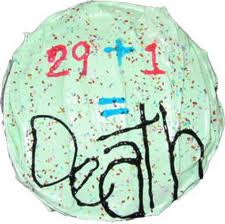
Oy vay. Starting my fourth (fourth!) decade on this planet was something I told myself wasn't a big deal. I'm most likely only a third of the way through my life, I thought generously. I've got milestones ahead of me that will hopefully count as the most memorable of my life....hopefully. But even the most optimistic thought cannot banish the fact that memories that seem fresh in my mind  (graduating high school, getting my driver's license) happened over a decade ago, which leads to me to think if I have really changed all that much in the ensuing years. Which then causes me to think that I have become what I never thought would happen: out of touch with whatever is considered "cool". Most of pop culture is a confusing mess to me nowadays. I've even caught myself saying 'back in my day....' And yet I'm told by people that I'm still just a young pup with his whole life ahead of him. That may be true, but my aching knees and increasingly crotchety behaviour say otherwise. We shall see where I am in the next 30 years. 

Watching my friends get on with their lives

This is an offshoot of the last entry, but it warrants it's own rant. Not so much rant, maybe, since there isn't much anger involved, more just melancholic realization. This is the year that good friends moved away, entering new chapters in their lives that, shockingly enough, don't include me as much as I would like. I will eventually pick up and move on too, but it's always hard when you're not the first to do so. Such a mixture of emotions, most of which were unexpected. Familiar blue sadness painted the canvas of my consciousness, but also red anger and green envy with splatters of ochre nostalgic reminiscences and the occasional trickle of bright white anticipation. A true emotional Pollock canvas, this saying goodbye to your best friends is. 

Listening to the album House of Balloons by The Weeknd

Out of nowhere, The Weeknd dropped a free mixtape called House of Balloons in March, and turned R&B on its head, at least for me. Abel Tesfaye, the man behind The Weeknd, sings songs about sex and drugs, but without all the posturing in a desperate attempt in glorification. Instead, the listener is bombarded with skin crawling hooks like bring your love baby, I can bring my shame/bring your drugs baby, I can bring my pain. Yeah, real uplifting, I know, but Tesfaye sells it so well, embracing debauchery in all it's discomfort, making insanely good music around it, and then giving it away for free. 

Seeing tUnE-YaRdS live 

What. A. Show. Seriously, I had heard that tUnE-YaRdS live was amazing from articles in The Village Voice and Pitchfork, but nothing could truly prepare me for such energy, crowd engagement, and sheer musicianship that tUnE-YaRdS brought to the small stage at Sugar Nightclub. It was an electrifying concert with zero filler, and listening to all the songs from my favorite album of the year live in such an intimate venue ranks as one of the highlights of the year, hands down.


These are just a few off the cuff experiences from the past 12 months of my life. By no means do they sum up the year for me tidily, not by any stretch of the imagination. But they all serve as signposts in my life as I, with the rest of you, hurtle into the unknown territory that is the next year. 2012 looms just on the horizon, almost in our grasp. Who knows, if the Mayans were correct this will be Interrobang's inaugural and sole Retrospecticus, unless I fervently tap an entry out on December 20th.


Only time will tell.


Friday, 16 December 2011

An Otherwise Dreary Day Punctuated by the Surreal

I have just finished Murakami's 1Q84, where the themes of death and rebirth (among many, many others) are explored in the haze of a dreamlike work only Murakami could create. So these topics are at the forefront of my mind whether I like it or not. So after finishing 1Q84, what do I choose for my next book? Hitch 22, a memoir of the British essayist, atheist, journalist, and wit Christopher Hitchens. I started it last night, December 15th. In the first chapter, Hitchens describes what it is like to read your own obituary, since he himself has experienced this. I'll explain: one day in 2008 he was featured in a photograph in an article for the New Statesman, and the caption referred to him as the late Christopher Hitchens. It turned out to be an error, of course, but seeing himself so matter-of-factly announced as having shuffled off this mortal coil rattled him. 

So what do I read the very next morning, December 16th? That Christopher Hitchens has indeed passed away and his obituary has been published, rightfully so this time around. This is a very sad day, for Hitchens is a dying breed among, well, that's hard to say. Among journalists. Among authors. Among outspoken critics and people with bon mots for pretty much any occasion. So raise a glass (or two, or three) of the finest brandy and light a Cuban cigar in honour of Christopher Hitchens. 


Saturday, 10 December 2011

Kindred Spirits

Last week I pondered how the genre of postmodern literature just may be too big for its britches. The books that fall under that category are too tricky, too wild, too unpredictable, and far too unlike each other to really belong in the same company. That also holds true for one of my favorite authors, Philip K. Dick. His novels and stories often fall under the same genre. You know, the genre that sits at the back of the class that no one really wants to talk to because it hasn't learned to wear deodorant yet. Yes, science fiction. 

Ask 100 people what genre of books or movies they generally shy away from. I'm sure you'll get a few serious dramas, some British comedies, and one or two "old classics" but I guarantee the majority will say science fiction. Why? Well, for starters, most people base their opinion on two things: Star Wars and Star Trek. These, sadly, are the ambassadors of sci-fi to the general public, but along with them come the creepy fans, the annual conventions, the costumes, and of course, the intense obsession about every last minute detail of both the Wars and Trek universes. Yes, these stereotypes for sci-fi fans exist for a reason, but they represent the absolute nadir. Unfortunately, the entire genre of sci-fi gets the brush off from just about everyone because of a few bad eggs, but if you look just a tad deeper, you can see just how fascinating and thought provoking sci-fi novels can be. And no other author has done more to expand sci-fi to its very limits than Philip K. Dick. 

You know Philip K. Dick even if you haven't heard of him. Many of his novels have been adapted into films, but Blade Runner (adapted from Do Androids Dream Of Electric Sheep) and Minority Report (adapted from his short story The Minority Report) are the two most famous and well known examples. Both films were very good, as was Richard Linklater's A Scanner Darkly, but I don't believe what makes Dick's books and stories so special can be necessarily translated into film. The movies themselves are pretty great in their own right, and are head and shoulders above some of the less memorable Dick adaptations (Next, Paycheck) but even the best can't capture the twisty, labyrinthine, poetic worlds Dick creates in his novels, often exchanging artfulness and subtlety for special effects.  Essentially, if you judge Philip K Dick solely on his contribution to cinema, then you really don't know Philip K Dick.


Okay, so where do you start? Dick has published 44 novels and over 120 short stories, so there's not exactly a dearth of material. He was, however,  never content to be confined in the genre trappings of science fiction, making his oeuvre notoriously difficult to penetrate. I would recommend Ubik as a perfect starting point. This 1969 novel encapsulates many of Dick's obsessions, namely paranoia, the questioning of reality, paranormal powers, and ultimately, faith, but wraps them in a cracking good story rich with humour and pathos. The plot is just the right amount of twisty for the novice reader, and is easy enough to follow right to its emotionally satisfying end. 


For those willing to venture further down the rabbit hole after finishing Ubik, there are many paths to take. The Three Stigmata of Palmer Eldritch is a horrifying acid trip of religious imagery and futuristic paranoia, The Man in the High Castle is an alternative history novel (some say the first) where President Roosevelt is assassinated and after America loses WWII, it is divided between the Germans and Japanese.  VALIS finds Dick at his most unhinged and autobiographical, diving headfirst into gnosticism, Christianity, Jungian psychoanalysis, and his own personal experiences as narrated by his doppleganger, Horselover Fat. 


As you can probably guess, Philp K. Dick was no ordinary sci-fi author. He abused amphetamines (often attributed to his seemingly non-stop publishing habits) and claimed he had visions; visions of Ancient Rome where he lived as "Thomas," a persecuted Christian. He also claimed that a pink laser beamed to him wisdom and clairvoyance, a plot point he made pivotal in VALIS. Dick's idiosyncrasies and paranoia were perfectly wed to his subject matter, elevating him to a cult figure with an intensely rabid fan base who pore over his works like, quite appropriately, religious texts. But Dick deserves a fate better than being a minor footnote in a genre held in such contempt. Philip K. Dick was a humanist above all else; no matter how hallucinogenic his stories became, they always have a human interest. There is sadness, curiosity, regret, confusion, joy, and longing suffused in his prose. It stands as a testament to this that the K. in Philip K. Dick stands for Kindred. 


Sunday, 27 November 2011

Current Obsessions

Here some things that are currently taking up far too much time in my life:

Silent films

 Ever since seeing Scorsese's masterful and completely enchanting Hugo, I want to seek out and watch all the old silent classics. Les Vampires, The Kid, City Lights, Sherlock Jr, The General, Sunrise, Safety Last. The list goes on. Hugo reminded me why I love movies in the first place: their complete and unparalleled ability to transport me to another place. There's something special about silent movies, something so incredibly pure and trustworthy about the images. Hugo also made me feel slightly guilty aI haven't had the urge in awhile to do a Keaton or Chaplin or Lloyd marathon, but that shall be remedied very soon. I also want to be primed for the release of The Artist, a movie I am very enthusiastically awaiting.

FlÜd Watches


I have their Big Ben in oak, and there are so many more I would love to have in my collection. They are unique yet fashionable watches that won't break the bank. The only thing to watch out for is that ridiculous $40.00 shipping charge to Canada. Ugh.

Theorizing how Breaking Bad will turn out


So will Jesse find out that Walter used Lily of the Valley to poison Brock? And what repercussions will Walt suffer from the murder of Gus Fring? Will Jesse turn out to be the Southern US meth kingpin while Walt continues to make awful choices about his family and career, ultimately leading to his (no doubt) bloody end? How will the showdown of Hank and Walter look? I shudder to think of all the meaty possibilities and glorious directions this show could follow. How does one end the best television program of the last decade? I can't even wait until next summer.

Stay tuned for more obsessions as they envelop me....

Postmodernism: or, How I Learned to Stop Categorizing and Love Contextual Definitions

Reading tastes vary wildly by individual. One person's classic is another's airport paperback. Thats fine with me, I have no want to argue the merits of the so called classics and where they stand in the pantheon of "great literature" or any such nonsense. To do so is an exercise in foolhardy blowhardism to which I haven't sunk in days. It just so happens, though, that many of my favorite authors and books fall into a certain broad, nebulous non-genre known as postmodernism.


What images are conjured when one rolls the word postmodern around their brain as if sucking on a lozenge? To me, the worst part of art and writing, ironically, come to mind. I picture gigantic pencil sculptures, nonsensical prose, and art installations meant to fulfill the onanistic desire of the artist and no one else. These images are not without merit, sadly, but to dismiss postmodernism entirely based on preconceived notions is to throw the baby out with the bathwater. I will address postmodern literature solely and not pretend to know enough about art to justifiably fill an entire blog post worth of ramblings based solely my own ignorance.

So, where and with whom do we start? Great question, I am wondering that myself.

Well, definitions are fun! 

 post·mod·ern·ism   [pohst-mod-er-niz-uhm] noun( sometimes initial capital letter ) any of a number of trends or movements in the arts and literature developing in the 1970s in reaction to or rejection of the dogma, principles, or practices of established modernism, especially a movement in architecture and the decorative arts running counter to the practice and influence of the International Style and encouraging the use of elements from historical vernacular styles and often playful illusion, decoration, and complexity.

 Well there you have it. Postmodern refers to anything that isn't established modernism. Need a definition of that? We could go on and on, falling down a rabbit hole of OED definitions in a Sisyphean task of defining something that simply cannot be defined. How very postmodern. Some claim that the playfulness of modernism as a means to an end yields to the playfulness in postmodernism as an end unto itself. Certainly a fuzzy boundary, as ones attempts to parse out T.S Eliot's The Wasteland and Laurence Sterne's Tristram Shandy and put them on opposite sides of a malleable spectrum. 

In order to gain purchase on such a spectral idea, we must look to examples of what is commonly referred to as postmodern literature and attempt to form a skeleton on which to hang our ad hoc definition. Which brings us back to the question, where do we begin? 

Thomas Ruggles Pynchon. That's where I will begin, since it's damn near impossible to have a conversation about postmodern lit without his inclusion. The notoriously camera shy author is the poster boy for many of the most popular facets of postmodernism. The combining of genres. The historical touchstones. The impenetrable narratives. The mixture of high and low art. The random asides. Even Pynchon's most linear works like The Crying of Lot 49 and Inherent Vice are ripe with postmodern flourishes, but if you want to dive in head first, tackle his magnum opus, Gravity's Rainbow. 

Seeing as entire books have been written attempting to elucidate to the reader what exactly Gravity's Rainbow is about, this blog will focus not on plot machinations (and if you've read it you'll know why) but on certain aspects that make it "postmodern". Gravity's Rainbow is funny. It's hilarious, really. It's full of moments of great physical comedy (the book centers around erections, after all) and endlessly quotable dialogue:

Death has come in the pantry door: stands watching them, iron and patient, with a look that says try to tickle me.

Black humor and irony are touchstones of postmodern lit. Other works that come to mind that embrace jet black humor are Kurt Vonnegut's Slaughterhouse Five and Philip Roth's Portnoy's Complaint (don't read either while sitting in a coffee shop, people will begin to question your sanity since you'll be cackling like the Joker). Both Gravity's Rainbow and Slaughterhouse Five also view historical events (in both books, WWII) through a lens of science fiction and fantastical occurrences. Time travel is treated as an common occurrence, and a single, sentient lightbulb named Byron is given a complete life story. Flourishes such as these don't really stick out in a postmodern novel, though. They simply are woven into the dense fabric of the prose. 

Density is often cited as another postmodern touchstone. This is not referring to the size of the book (although postmodern works can be very, very long) but rather to the knotty, often impenetrable plots and seemingly random characters that populate the story. Pynchon's The Crying of Lot 49 is a relatively slim novel, but is so packed with asides, frayed plot threads, paranoid rumblings, and random songs that it takes a lot of concentration to wade through it all. One Hundred Years of Solitude is another relatively small novel (at least in comparison to tomes like Against the Day and 2666) often cited as postmodern (and the figurehead of a subsection of postmodernism called magic realism) that reads like it was twice as long since it blends so much together (an entire family tree from roots to canopy). 

This post could continue picking out aspects of postmodernism and highlighting the novels that exemplify the genre, but Jesus my eyes are getting sore staring at this screen. Honestly, it is exhausting just thinking about postmodern lit, since most of the books I enjoy are folded into it for so many different reasons. Murakami.  Vonnegut. Pynchon. DeLillo. McCarthy. Roth. Irony. Black humor. Intertextuality. Pastiche. Satire. Is this a testament to the breadth of postmodern qualities, or to my narrow reading list? Who knows for sure, but I suspect the former rather than the latter. 

When it really comes down to it, if a book that was published post 1941 (the year both James Joyce and Virginia Woolf died, which to some signifies the end of modernism and by definition the beginning of postmodernism) contains any element that makes it odd, unique, or individual, you can wrap it up in a nice postmodern packaging and slot it neatly away. And this nonsense about postmodern novels using "playfulness" as an end rather than a means, as if the author was writing it solely to puzzle readers and be dissected by scholars, well that's a load of tripe. Vonnegut wrote about his experiences during WWII the only way he could, and Slaughterhouse Five is filled with as much melancholy, heartbreaking emotion as any Brontë or Dickens novel. And the density of some novels, specifically those by Pynchon, should be embraced. Who says everything has to be neatly laid out, from point A to point Z, in a digestible, linear fashion? It's tremendous fun to be lost in a labyrinth; adrift in literary puzzle where structure is eschewed in favor of flights of imagination, regardless to whatever locked doors or dead ends they may lead to. 

I suppose my gripe with the word postmodern is that it describes so many genres and styles that it describes nothing at all. Besides, what comes after postmodern? Post postmodern? Yes, actually. This type of naval gazing can go on and on ad infinitum, becoming an unwieldy ouroboros bent on making a mockery of the entire literary classification system as a whole! Sigh. It's time to wrap this post up. 

Take home message? Read books. A lot of them. By lots of different authors, alive or dead. If you like a book by a certain author read more by them. If you don't like a book by a certain author, seek other authors out. If you don't like Gravity's Rainbow, don't assume you won't like any other postmodern work by any other author. They vary so wildly in terms of plot, writing style, and character that it's moot to clump them together at all. 

Oh, and read lots and lots of Philip K. Dick. His books will make you a better person. I know they did that for me. 

That is all. 


Words to Live By #9

“Why should things be easy to understand?” 


--Thomas Pynchon 


What better quote to precede a post on postmodernism than this gem by none other than Thomas Pynchon, who very nearly summarizes the entire idea of postmodernism in every novel he writes.

Sunday, 13 November 2011

The Vice of the Aged?

I admit that I am somewhat of a nostalgia junkie, although, unlike some that long for the past, I pine not for a simpler time, but for a more passionate one. A caveat is required for my claim, however. I am not saying that the present day finds nothing to be passionate about, quite the opposite is true for many people around the world. Governments are being overthrown, economies challenged, social order turned on its head, all achieved by people ignited with passion. All the power to them, but I feel removed, at a distance. Ironic seeing as social media places the worlds strife and conflict right on my iPad, but still, there is no connection to the current state of affairs and the fire in my heart.

Recently seeing Woody Allen's most recent film Midnight in Paris stirred up so many wonderful memories and emotions in me. In it, Owen Wilson plays a man so consumed with 1920s Paris, so taken with that era of nostalgia, of Hemingway and Fitzgerald, Dali and Modigliani, that he travels back in time every night at midnight, and lives out his fantasies of interacting with his "golden age" heroes. For me, the city is right, but my "Golden age" is about four decades later.

Flash back to Paris 1959, where my passion truly lies. The nouvelle vague seeds of French cinema have been planted by previous eras, specifically Italian neorealism (de Sica and early Fellini), and Hollywood films (Hitchcock and film noir in particular) and bloomed into rare and unnameable roses of cinema. French cinema pre-nouvelle vague is nothing to take for granted, producing incredibly talented filmmakers and some of the most honoured movies of any generation. But for my money, the films produced between 1959 and 1968 represent the most fertile period of filmmaking in history.

What I wouldn't give to have been at the premiere of Jean Luc Godard's 1960 film Breathless. This is the film that arguably started it all, with it's experimental editing, on-the-fly shooting style, and melange of genres. Breathless was a slap in the face to all the stilted, studio-shot, creatively bankrupt films that came before it, in any genre. When viewed alongside Resnais' Hiroshima mon Amour and Truffaut's Les Quatre Cent Coups one can see steps being taken in a new, bold direction embodying politics, love, rebellion, and sex in a whole new way.

My church

But it is not merely the abundance of great films, directors, and actors that make me longingly gaze into the past. It is what these films meant to and the passion they ignited in the people of France at the time that make this a golden age for me, and here's where my nostalgia kicks in at full force. People cared about cinema, they argued ceaselessly over the filmmaker's message. They were passionate and engaged. They thought that movies could change the world, shape the war, or make a girl fall in love with you. And they could. Nowadays, you get blockbusters and indie films, a few great, some good, most not. But even the great ones never feel dangerous, like they could incite riots or change peoples' long held beliefs. I long for a time when people young and old protested the forced resignation of Henri Langlois, the co-founder of the Cinémathèque Française theatre, causing an international uproar so deafening that the Cannes Film Festival was put on hold that year. Needless to say, Langlois stayed put. Had I been alive in 1968, I would have chained myself to the gates of the Cinémathèque alongside countless other protesting cinephiles with pleasure.

Some say nostalgia is a dangerous pastime relegated to those who haven't the constitution to deal with the present. I cannot embrace this logic, insofar as the past is inextricably linked to the present, or, as the old adage goes, those who forget history are doomed to repeat it. Of course (and this point is made beautifully in Midnight in Paris) someone's past is another's present. I often wonder if people living in '68 Paris knew how influential their era truly was. I would imagine not, which begs the question of how will 2011 be remembered and immortalized a generation or two down the line?

Now if you'll excuse me, I've got a flux capacitor to repair.